

Achalasia is a rare but serious condition that most people have never heard of yet it could be the real reason food keeps getting stuck in your chest. Many patients spend months blaming stress, anxiety, or acid reflux, never realising there is a name for what they are going through. The longer it goes unrecognised, the worse it gets.
Here are five signs that what you are experiencing may be more than just a nervous stomach.
- REASON 01 Food and liquids feel like they’re stuck in your chest
This is the hallmark symptom of achalasia and it’s often dismissed as ‘eating too fast.’ In reality, when the oesophagus loses its ability to push food downward and the lower valve fails to open properly, every meal becomes a struggle. This kind of swallowing difficulty happens with both solids and liquids something that doesn’t typically occur with simple reflux.
- REASON 02 You regurgitate undigested food hours after eating
Unlike vomiting, this regurgitation is effortless food comes back up without nausea or stomach acid. It may happen while lying down or even during sleep, which also puts you at risk of inhaling food particles into your lungs. Many achalasia patients describe it as food simply ‘coming back up on its own.’ This is a significant warning sign that deserves proper investigation.
- REASON 03 You’ve been told it’s GERD but the treatment isn’t working
This is one of the most frustrating parts of living with undiagnosed achalasia. Because chest discomfort and swallowing issues overlap with acid reflux symptoms, many patients spend months or years on antacids with little relief. If your ‘GERD’ doesn’t respond to standard treatment, it’s worth asking your doctor whether achalasia could be the real cause.
- REASON 04 You’re losing weight without trying to
When eating becomes painful or difficult, people naturally start avoiding certain foods or eating less altogether. Unintentional weight loss combined with swallowing difficulties is never something to ignore. It suggests achalasia has been progressing silently for a while and needs urgent attention.
- REASON 05 You wake up coughing or choking at night
Food and liquid pooling in the oesophagus doesn’t just stay there it can spill into the airway during sleep. Chronic night-time cough, frequent chest infections, or a persistent feeling of something in the throat are all common in achalasia patients. Many are treated for asthma or sinusitis for years before the real diagnosis is found.
So what exactly is happening inside the body?
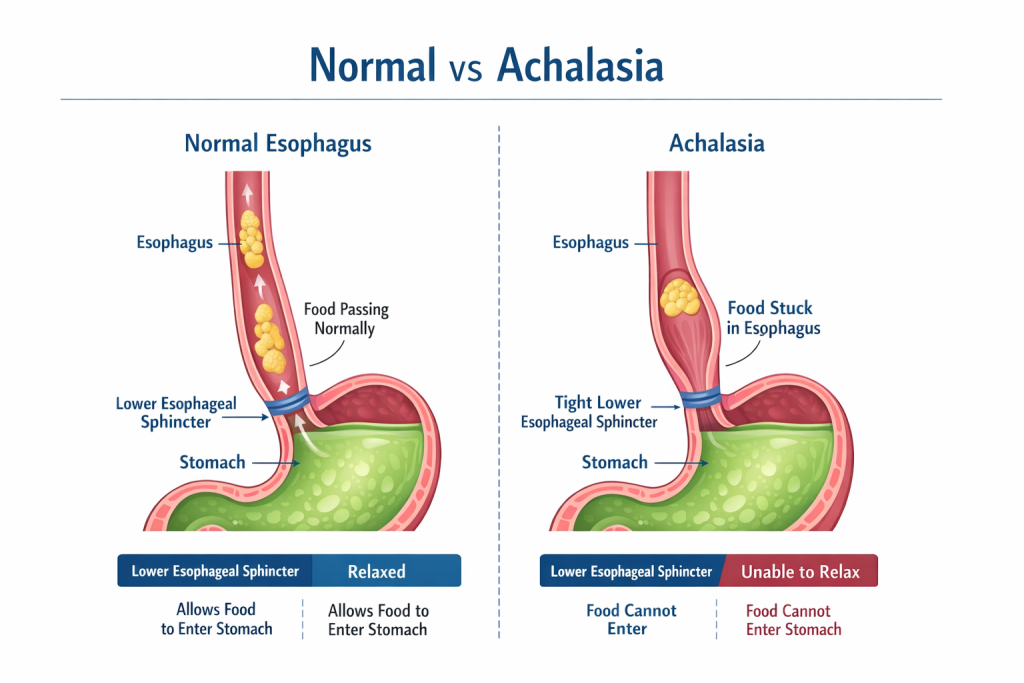
The oesophagus is a muscular tube that moves food from your mouth to your stomach. At the bottom sits a ring of muscle called the lower oesophageal sphincter, which normally opens to let food pass. In this condition, the nerves controlling this sphincter are damaged so it stays shut, and the oesophagus itself loses its ability to push food downward. Food simply has nowhere to go.
The exact cause is still being studied, but it is not related to diet, stress, or lifestyle. It is a nerve condition and it is treatable.
How is it diagnosed?
Three tests are typically used:
- High-resolution manometry measures the pressure and movement inside the oesophagus. This is the most accurate test.
- Barium swallow X-ray shows the classic ‘bird beak’ narrowing at the bottom of the oesophagus.
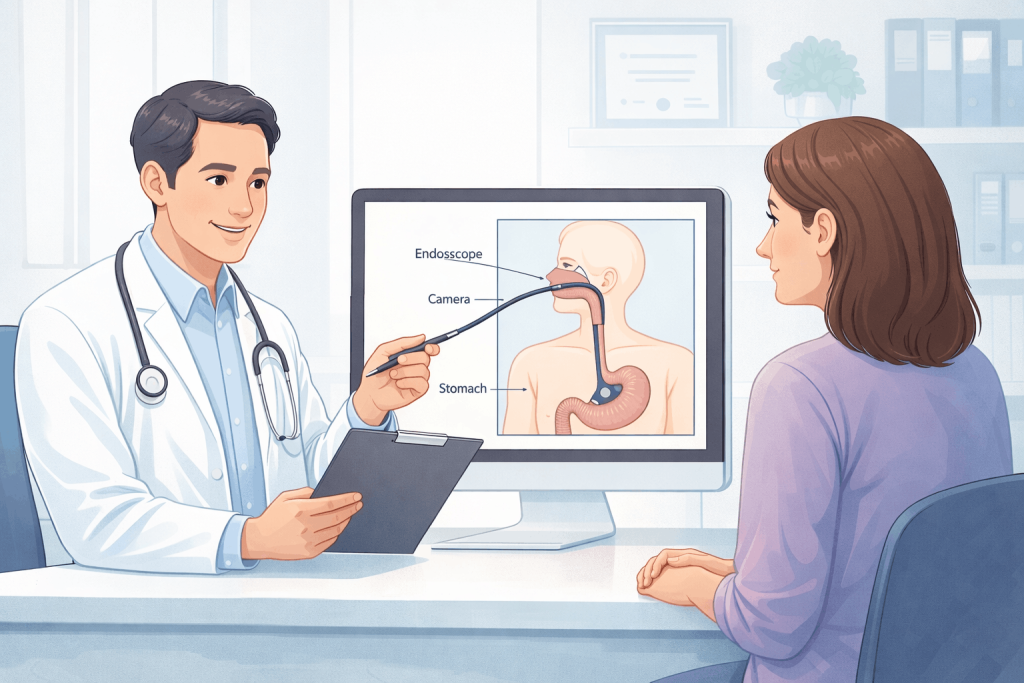
- Endoscopy rules out other conditions like cancer or strictures that can mimic similar symptoms.
What are the treatment options?
The good news is that several effective treatments exist. The goal of all of them is to relax or widen the tight lower sphincter so food can pass through normally.
- Pneumatic dilation: a balloon is used to stretch open the sphincter during an endoscopy procedure.
- POEM (Per-Oral Endoscopic Myotomy): a minimally invasive procedure that cuts the tight muscle from the inside, with excellent long-term results.
- Heller myotomy: a surgical option that achieves the same result through keyhole surgery.
- Botox injection: a temporary option, mainly used for patients who are not fit for other procedures.
Your gastroenterologist will recommend the best approach based on your age, overall health, and how advanced the condition is.
When to seek help immediately
If you are losing significant weight, cannot swallow liquids, or are choking at night please do not wait. These are red flag symptoms that need prompt evaluation. Early diagnosis leads to significantly better outcomes. Our gastroenterology team at Medigest Gastro & Liver Clinic specialises in diagnosing and treating oesophageal conditions. Don’t spend another year wondering what’s wrong.