

You’ve tried the face washes, the serums, the “dermatologist recommended” creams. Maybe you’ve even gone through a round of antibiotics. And yet — same breakouts, different Tuesday.
Here’s something most skin-care content won’t tell you: the problem may not be on your face at all. Gut health and acne are directly connected, and the research backing this up is no longer fringe or experimental. It’s showing up in peer-reviewed journals, with real patient numbers behind it. Doctors who treat chronic skin conditions are increasingly looking at the gut first — because the gut health and acne link explains what topical treatments simply can’t.
So before you buy another spot treatment, read this first.
What Is the Gut-Skin Axis?
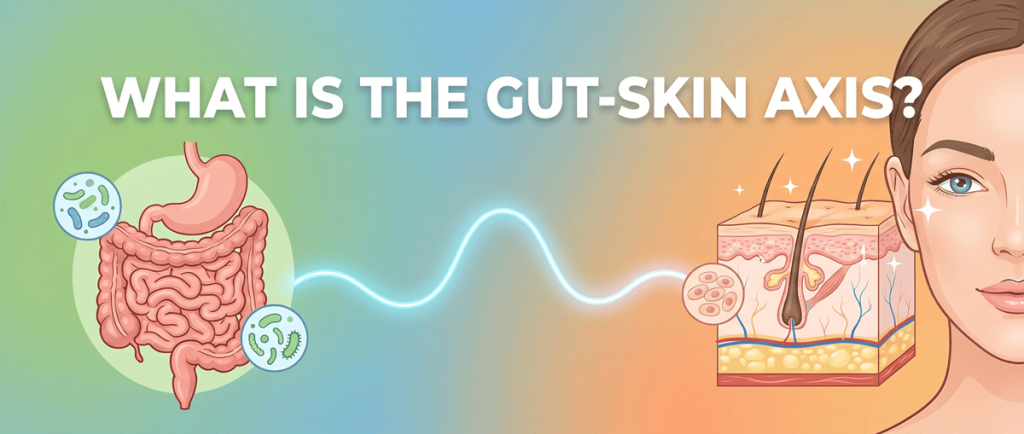
Your gut and skin talk to each other constantly. Scientists call this communication pathway the gut-skin axis — a two-way channel where what happens in your digestive tract shows up (sometimes literally) on your face.
Your gut holds trillions of microorganisms — bacteria, fungi, viruses — known collectively as the gut microbiome. These aren’t passive passengers. They regulate immune responses, produce neurotransmitters, control inflammation, and affect how your organs function. Skin included.
When the microbial balance is stable, your body manages inflammation quietly in the background. When it’s not — a state called dysbiosis — things start going wrong in ways that aren’t always obvious. This is the core of the gut health and acne problem: the fire is coming from inside, which is why no topical treatment can fully put it out.
How Gut Health and Acne Are Linked
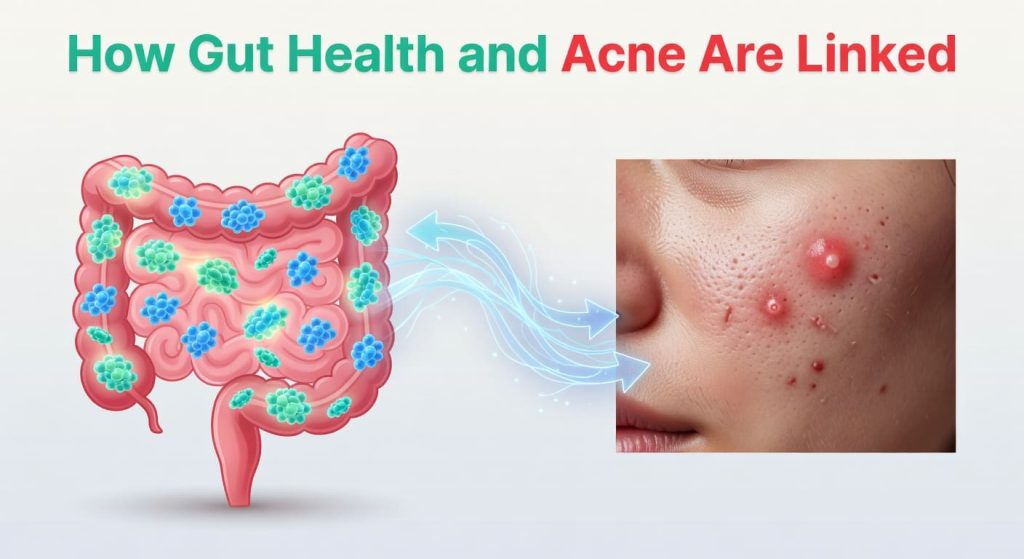
The connection between gut health and acne is backed by hard numbers, not just theory. A 2024 review of over 185,000 acne patients found that many had co-existing gut conditions — IBS, peptic ulcers, constipation. Not a coincidence.. A separate 2021 study found that 61% of acne patients had an IBS diagnosis, a rate significantly higher than in people without acne.
That’s a big number. More than half.
A 2024 paper in Scientific Reports went further, using Mendelian randomization — a method that helps establish causation, not just correlation — to map the relationship between 412 gut microbe types and acne. Specific microbial imbalances came up linked to active breakouts.
Three mechanisms explain most of it:
- Immune misfires — Your gut microbes help train your immune cells. When the microbiome is disrupted, immune signals go haywire, producing chronic low-level inflammation that surfaces on your skin.
- The mTOR pathway — Gut microbes interact with cellular signaling pathways that regulate skin cell behavior. mTOR expression is measurably higher in acne-prone skin, and gut bacteria appear to influence this.
- Leaky gut — When gut lining integrity breaks down, bacterial toxins (LPS endotoxins) enter the bloodstream. Your immune system responds, inflammation follows, and your skin gets caught in the crossfire.
These three mechanisms rarely act alone. When your gut microbiome is disrupted, you often feel it in more ways than just your skin — post-meal bloating, sluggishness, and even that heavy fatigue after eating that many people dismiss as “just how it is.” If that sounds familiar, here’s what’s likely behind it.
5 Proven Ways Your Gut Triggers Breakouts
1. Dysbiosis — Your Good Bacteria Are Losing Ground
Lactobacillus and Bifidobacterium are two bacterial strains consistently found at lower levels in people with persistent acne. When harmful bacteria crowd them out, inflammation rises across the whole body — not just in the gut.
2. Leaky Gut
When the intestinal wall weakens, toxins and undigested food fragments enter the bloodstream. Your immune system doesn’t recognize them and attacks. That immune response creates inflammation, and your skin bears a lot of it.
3. A Diet Built on Sugar and Maida
Refined carbs cause blood sugar spikes. Insulin rises. That triggers IGF-1 (Insulin-like Growth Factor), which directly increases sebum production and speeds up skin cell turnover — both key drivers of clogged pores. On top of that, sugar kills off the beneficial bacteria your gut needs. It’s a double hit.
4. Stress (Taken More Seriously Than You’d Expect)
Chronic stress raises cortisol, which disrupts gut bacteria composition and drives skin inflammation. Research has confirmed a three-way gut-brain-skin axis — meaning gut problems worsen your stress response, and stress worsens gut health. They feed each other. Breaking the cycle requires addressing both.
5. Antibiotic Overuse
Antibiotics clear bacterial infections. They also wipe out beneficial gut strains with no discrimination. If you’ve done multiple antibiotic courses — common in acne treatment — your gut microbiome may still be recovering, months or years later. That recovery gap keeps the inflammation going.
What to Eat (and Avoid) for Clearer Skin
The good news for Indian readers: a traditional Indian diet is actually quite gut-friendly. A lot of what your grandmother cooked has modern science behind it now.
Eat More Of:
The right diet is one of the most direct ways to work on gut health and acne together — and the good news is, most of these foods are already part of an everyday Indian kitchen.
- Fermented foods — Curd (dahi), chaas, idli, dosa, and homemade pickles all carry live Lactobacillus cultures. Eat them daily, not as a supplement — as food.
- Prebiotic foods — Garlic, onion, bananas, oats, and dal feed the good bacteria already in your gut. Prebiotics and probiotics work together.
- Omega-3 sources — Walnuts, flaxseeds, and fatty fish reduce systemic inflammation. This matters because inflammation is what turns a clogged pore into a full breakout.
- Antioxidant vegetables — Spinach, carrots, broccoli, and amla fight oxidative stress in skin cells. Amla in particular has strong anti-inflammatory properties backed by Indian traditional medicine and modern research both.
- Water — Eight to ten glasses a day. Not glamorous advice, but the gut lining and skin barrier both depend on hydration to function.
Cut Back On:
- Maida-based foods — bread, biscuits, namkeen, fried snacks
- Excess dairy, especially milk (contains IGF-1 that can push sebum production higher)
- Packaged and ultra-processed foods
- Artificial sweeteners — they disturb microbial diversity even without adding sugar
On supplements: Strains like Lactobacillus acidophilus, Bifidobacterium bifidum, and Lactobacillus plantarum have shown results in clinical studies for reducing acne severity. But supplements are not a replacement for diet changes — they work alongside them. Talk to your doctor before starting anything new.
Common Mistakes People Make
Relying only on topicals. Creams and face washes treat what you can see. They don’t address what’s driving the inflammation internally. If your gut is the source, skincare alone won’t hold.
Quitting probiotics after one week. Your microbiome doesn’t rebuild in a week. Give it 4–8 weeks of consistent effort. Skin changes come after gut changes, not alongside them.
Going cold turkey on dairy. Cutting everything at once can stress your system further. Reduce gradually. Pay attention to what actually shifts for you — everyone’s gut is different.
Dismissing stress as a factor. It’s easy to write off stress as an excuse. But the gut-brain-skin connection is well-documented. Ten minutes of walking or deep breathing daily isn’t a cure, but it genuinely moves the needle on cortisol — and cortisol moves the needle on your skin.
Frequently Asked Questions
Q: Can gut health actually clear acne?
It can meaningfully reduce it. The research on gut health and acne now spans hundreds of thousands of patients across multiple peer-reviewed studies, all pointing to gut microbiome imbalance as a real driver of acne severity. It’s not a guaranteed fix, but for people with persistent breakouts that don’t respond to topical treatment, gut health is often the overlooked piece of the puzzle.
Q: How long before I see results?
A: Most people notice changes in 4–8 weeks with consistent diet adjustments and probiotic use. Your microbiome rebuilds slowly — the skin reflects that timeline.
Q: Which Indian foods help most with gut health and acne?
A: Dahi, chaas, idli, amla, haldi, dal, and leafy greens are your best starting points. They’re affordable, available everywhere, and genuinely effective — not just traditional wisdom.
Q: Should I stop my acne medication while working on gut health?
A: No. Never stop prescribed medication without your dermatologist’s input. Gut health work is most effective as an add-on to medical treatment, not a replacement for it.
Most acne advice focuses outward — better products, better routines, better technique. This one points inward. Your gut drives more of your skin’s behavior than most people realize, and the fix doesn’t come in a bottle from the pharmacy shelf.
Start with your food. Give it time. And if your acne has always felt like something deeper was behind it — you were probably right.