
You finished the antibiotics. The stomach feels calmer. So, is the infection gone? Not always. An H pylori test after treatment is the reliable way to find out, because symptoms can settle even when the bacteria are still there.
Treatment does not work for everyone. An IARC (WHO cancer research agency) report on H. pylori states that eradication rates are far from 100% with any regimen, and that success should be checked with a follow-up test. Timing and medicines matter more than most people expect.
Why Retesting Matters
Most people with H. pylori have no clear symptoms. That makes "I feel better" a weak signal. Relief can come from the acid-reducing medicine alone, while the bacteria stay.
The 2024 American College of Gastroenterology guideline on H. pylori treatment recommends follow-up testing at least 4 weeks after therapy is completed. That guideline is written for North America, so your doctor may adjust the plan for local antibiotic resistance patterns in India.
Here is a number worth noticing. A US consensus conference report found that gastroenterologists said they confirmed eradication in only about 58% of cases. Less than 6 in 10. Skipping the retest is common, even though it is advised.
Which Tests Are Used to Confirm It Is Gone
Three options are used for an H pylori test after treatment :
- Urea breath test: You drink a solution containing labelled urea, usually after fasting. If H. pylori is present, it breaks down the urea, and labelled carbon dioxide shows up in breath samples taken about 20 to 30 minutes later.
- Stool antigen test: A stool sample is checked for H. pylori proteins. Its accuracy is similar to the breath test. Collecting the sample is simply unpleasant for some people.
- Biopsy during endoscopy: A small tissue sample is taken from the stomach lining during an upper GI endoscopy. Because endoscopy is an invasive test with its own small risks, it is usually kept for people who need one anyway, for example to check how a stomach ulcer is healing.
Your doctor chooses based on your situation, availability and your other symptoms.
When to Do the H Pylori Test After Treatment
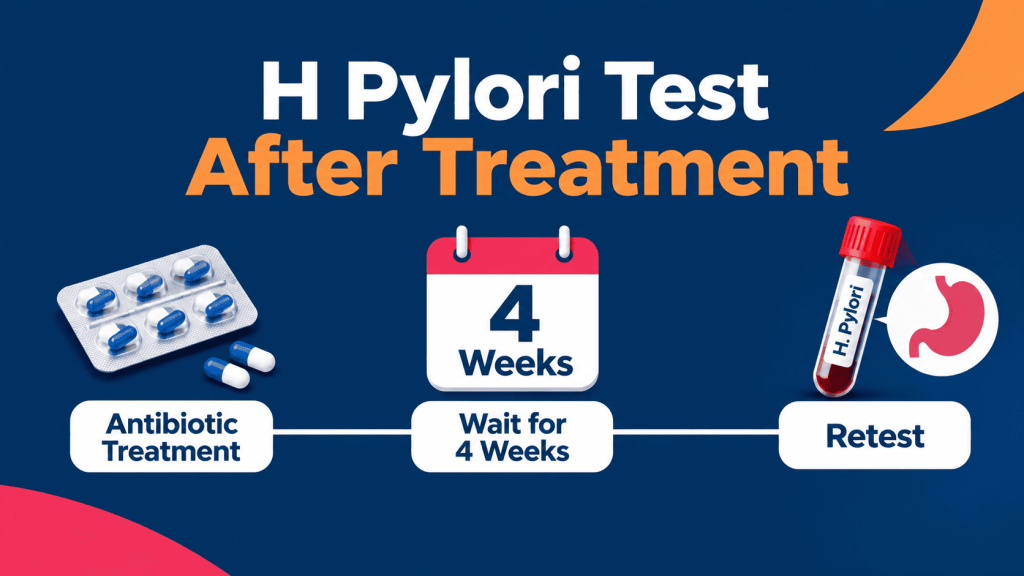
Timing is where most results go wrong. The general rule is to test at least 4 weeks after your last antibiotic dose. Test earlier and the bacteria may be too few to detect, which can give a false negative.
Acidity medicines matter too. Proton pump inhibitors (the common "acidity tablets") can also cause false negatives, so doctors usually ask for a gap of one to two weeks before the test. Bismuth preparations can have a similar effect. H2 blockers do not usually interfere, according to the MSD Manual.
| Factor | General guidance |
|---|---|
| Antibiotics | Wait at least 4 weeks after the last dose |
| Proton pump inhibitors | Usually stopped 1 to 2 weeks before, only if your doctor says so |
| Bismuth preparations | Can affect the result, so mention them |
Please do not stop any prescribed medicine on your own. Ask the treating doctor how to plan the gap, especially if you have an ulcer.
Common Mistakes People Make
Testing too early. Getting an H pylori test after treatment in the first week or two feels responsible, but it is the most common reason for a misleading "negative".
Using a blood antibody test. Antibodies can stay positive for a long time after the bacteria are gone, up to about 3 years according to the MSD Manual. So blood tests are not used to confirm cure.
Treating symptom relief as proof. Stomach discomfort has many causes. Feeling fine does not tell you whether the infection is cleared.
Stopping the course halfway. Skipping doses is a known reason treatment fails. Finish what was prescribed, and ask before changing anything.
Counting on probiotics or home remedies. The ACG guideline found insufficient evidence that probiotics improve how well eradication therapy works. They are not a replacement for the follow-up test.
If the Result Is Still Positive
A positive result on an H pylori test after treatment does not mean you did something wrong. It usually means the first regimen did not fully clear the bacteria, often because of antibiotic resistance.
Repeating the same course is generally not the plan. The ACG guideline suggests a different regimen for persistent infection, and some doctors use antibiotic susceptibility testing to choose it. For background on symptoms, diet and first-line treatment, see our guide on H. pylori infection symptoms, treatment and foods.
When to See a Doctor

Medical evaluation is advised in situations like these:
- Symptoms continue or return after finishing treatment
- Black or tarry stools
- Vomiting blood
- Difficulty swallowing
- Persistent vomiting
- Unexplained weight loss
- Severe or worsening upper abdominal pain
Frequently Asked Questions
Q: When should I do an H pylori test after treatment?
A: Usually at least 4 weeks after your last antibiotic dose. If you take acidity medicines, your doctor may also ask for a gap of one to two weeks before the test, so confirm the plan with them first.
Q: Can a blood test confirm that H. pylori is gone?
A: Not reliably. Antibodies can remain detectable for a long time even after successful treatment, so blood tests are not used to confirm cure. A breath test, stool antigen test or biopsy is preferred.
Q: Can I take my regular acidity medicine before the test?
A: It depends on the medicine. Proton pump inhibitors can cause a false negative, while H2 blockers usually do not. Ask the doctor who prescribed it before changing anything.
Q: What if the test is still positive after treatment?
A: It means the bacteria were not fully cleared, which happens in a share of cases. Your doctor will usually suggest a different treatment plan rather than repeating the same one.
If you have finished treatment and are unsure about retesting, ask the doctor who prescribed it which test suits you and when to do it. Carry a list of every medicine you are taking, including acidity tablets, because it changes the timing. Details on how remote follow-up works are on the online gastroenterologist consultation page.