
Jaundice means yellowing of the eyes and skin. In many people it comes from the liver itself, for example during hepatitis. But in some, the liver is working fine and the problem lies further down: the bile it makes cannot get out. This is called obstructive jaundice, and finding it early matters, because the cause is often treatable without open surgery. Here is what it is, how it is found and how it is treated.
What is obstructive jaundice?
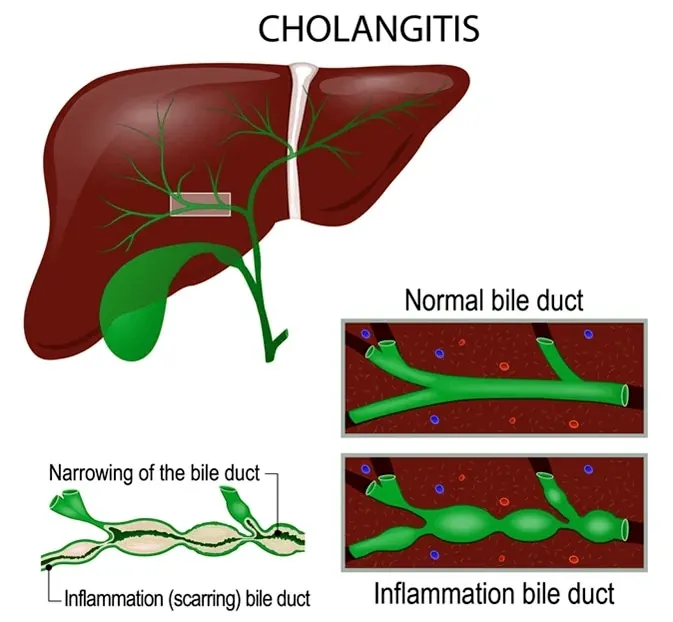
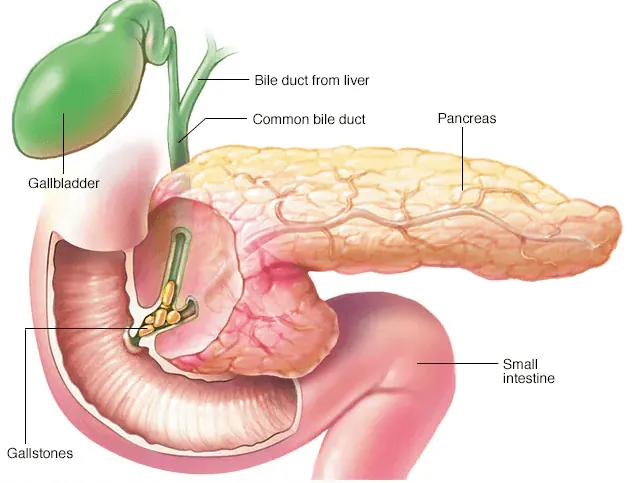
The liver makes bile, which flows through the bile ducts into the small intestine to help digest fat. Bilirubin, the yellow pigment, leaves the body this way. When something blocks the bile duct, bile backs up into the liver and bilirubin spills into the blood. The eyes turn yellow, the urine turns dark, and the stools become pale, because no bile reaches the gut. This is obstructive jaundice, also called cholestatic or post-hepatic jaundice. For jaundice in general, read what jaundice means.
Symptoms of obstructive jaundice
- Yellow eyes and skin
- Dark, tea-coloured urine
- Pale, clay-coloured stools
- Itching all over, often worse at night
- Pain in the upper right abdomen, especially with stones
- Fever with chills, if the bile becomes infected
- Loss of appetite and weight loss, especially with tumours
One pattern deserves special attention: painless jaundice with weight loss in someone over fifty. This can be a sign of a tumour near the bile duct or pancreas and should be investigated without delay.
Causes
The commonest causes we see are:
- Stones in the common bile duct: by far the most frequent cause. Read about CBD stone symptoms and treatment.
- Narrowing (stricture) of the bile duct: after gallbladder surgery, from chronic pancreatitis or from inflammation.
- Tumours: cancer of the head of the pancreas, the bile duct (cholangiocarcinoma), the ampulla or the gallbladder. Gallbladder cancer is more common in North India than in most parts of the world.
- Chronic pancreatitis squeezing the lower bile duct.
- Less common causes such as choledochal cysts, parasites or enlarged lymph nodes.
When it is an emergency
Jaundice with fever and shivering can mean the trapped bile is infected (acute cholangitis). This can become serious within hours and needs antibiotics and urgent drainage, usually by ERCP. Confusion, very low blood pressure or reduced urine are also danger signs. Go to the nearest hospital emergency department; do not wait for an appointment.
How obstructive jaundice is diagnosed
Blood tests show a high bilirubin, mainly the "direct" or conjugated type, with high ALP and GGT. Clotting tests are checked, because vitamin K, needed for clotting, is absorbed with the help of bile.
Ultrasound is the first scan. A widened (dilated) bile duct tells us there is a blockage, and often shows gallstones.
MRCP or CT scan shows where the blockage is and what is causing it. We explain how MRCP differs from ERCP in MRCP vs ERCP.
Endoscopic ultrasound (EUS) gives close-up pictures of the lower bile duct and pancreas, finds small stones or tumours that scans miss, and allows a needle biopsy. A blood test called CA 19-9 may be added if a tumour is suspected, though it can also be raised by blockage alone.
Treatment: relieve the blockage, then treat the cause
Treatment has two goals: get bile flowing again, and deal with whatever caused the blockage.
- ERCP: the main treatment. Stones are removed, and narrowings or tumours are bridged with a stent so bile drains into the intestine. There is no cut on the body. See the ERCP procedure page, and our guide to the ERCP stent if one is placed.
- EUS-guided drainage: when ERCP is not possible, for example when a tumour blocks the duodenum, the bile duct can be drained into the stomach or duodenum under ultrasound guidance.
- PTBD: drainage through the skin into the liver, done by an interventional radiologist when endoscopic drainage is not suitable.
- Surgery: to remove the gallbladder after stones, or to remove a tumour when it is operable. Not every patient with a tumour needs a stent before surgery; this is decided with the surgeon.
Once the bile drains, the itching usually eases within days, the urine lightens and the yellow colour fades over a couple of weeks. Blood tests are repeated to confirm the improvement.

Why speed matters
A blocked bile duct does not usually clear on its own. The longer bile stays trapped, the higher the chance of infection, kidney strain, bleeding problems and, with tumours, of the illness moving beyond the point where surgery is possible. Most of the tests above can be arranged within days, so there is no reason to wait for the yellow colour to fade by itself.
Questions to ask your doctor
- Is my jaundice from the liver itself or from a blockage?
- Where exactly is the blockage, and what is causing it?
- Do I need MRCP, CT or EUS next, and how soon?
- Will I need ERCP and a stent, and is it urgent?
- If a tumour is suspected, when will I meet a surgeon or oncologist?
Looking after yourself while jaundiced
- Drink enough fluids; jaundice and dye-based scans can strain the kidneys.
- Eat small, low-fat meals if fatty food upsets you.
- Avoid alcohol and any herbal or "liver cleanse" remedies.
- Do not take painkillers or new medicines without checking with your doctor.
- Report fever, worsening pain or bleeding straight away.
Obstructive jaundice treatment in Delhi
Dr. Shrihari Anikhindi is an advanced endoscopist with a special interest in ERCP and EUS, and has published research on EUS-guided bile drainage. Patients with jaundice from Punjabi Bagh, Paschim Vihar, Rajouri Garden, Janakpuri and across Delhi start at Medigest in West Punjabi Bagh, where reports are reviewed and the next test is planned quickly. ERCP and EUS are performed at Apollo Hospitals. You can book a consultation, or send your ultrasound and blood reports for an online consultation. For long-term liver problems, see our liver specialist care in Delhi.
Yellow eyes always need an explanation. When the cause is a blocked bile duct, the right test and an early drainage procedure can turn a frightening illness into a short hospital visit.
Medically reviewed by Dr. Shrihari Anikhindi, MBBS, MD, DNB (Gastroenterology), MRCP (SCE), gastroenterologist and advanced endoscopist at Medigest Gastro, Liver & Endoscopy Clinic, West Punjabi Bagh, Delhi. This article is general information. Please talk to your own doctor about your health.