
If you have had an ERCP, there is a good chance you went home with a stent in your bile duct and a date written on your discharge card. That date matters more than most people realise. This article explains what an ERCP stent is, why it is placed, how long it can stay and what stent removal involves.
What is an ERCP stent?
A stent is a small tube placed inside the bile duct (or sometimes the pancreatic duct) during an ERCP procedure. It holds the duct open so that bile can flow from the liver into the intestine. One end sits in the duct and the other end sticks out slightly into the duodenum, where the doctor can reach it later with an endoscope. You cannot feel a stent once it is in place.

Why a stent is placed
- Bile duct stones that could not all be removed: very large or many stones may need a second ERCP. A temporary stent keeps bile flowing until then. Read more about CBD stones.
- Narrowing (stricture) of the bile duct: after surgery, chronic pancreatitis or inflammation. Stents are changed every few months to slowly widen the narrowing.
- Blockage from a tumour: in cancers of the pancreas, bile duct or gallbladder, a stent relieves jaundice and itching, before surgery or chemotherapy, or as the main treatment.
- Bile leak: after gallbladder or liver surgery, a stent lets bile flow the easy way so the leak heals.
- Pancreatic duct stent: a tiny temporary stent is sometimes placed to reduce the risk of pancreatitis after a difficult ERCP.
Plastic stents and metal stents
Plastic stents are thin, cheap and easy to remove. Their weak point is that bile sludge slowly builds up inside them, and they tend to block after about three months. That is why plastic stents are changed or removed within roughly three months.
Metal stents are self-expanding mesh tubes, much wider than plastic ones, so they stay open longer, often many months. They are mostly used for blockages caused by cancer. "Covered" metal stents have a lining and can be removed; "uncovered" metal stents grow into the duct wall and are usually permanent.
Your doctor chooses the type based on the cause of the blockage and the plan ahead. Ask which kind you have and write it down.
How long can an ERCP stent stay in?
For plastic bile duct stents, the usual answer is no longer than three months. Covered metal stents may stay longer, depending on why they were placed. Small pancreatic stents placed to prevent pancreatitis usually fall out on their own within a week or two; an X-ray confirms this, and if it has not passed, it is removed.
The real danger is a forgotten stent. A blocked stent left for many months can cause serious infection of the bile (cholangitis), stones forming around the stent and jaundice. We see this every year, usually in someone who felt well and assumed the stent could stay. Please keep your date.
Signs your stent may be blocked
- Fever with chills or shivering
- Yellow eyes or skin coming back
- Dark urine and pale stools
- Itching
- Pain in the upper right abdomen
Fever with jaundice after a stent needs urgent attention. Go to the nearest hospital emergency department; this is not something to wait out at home.
ERCP stent removal: what to expect
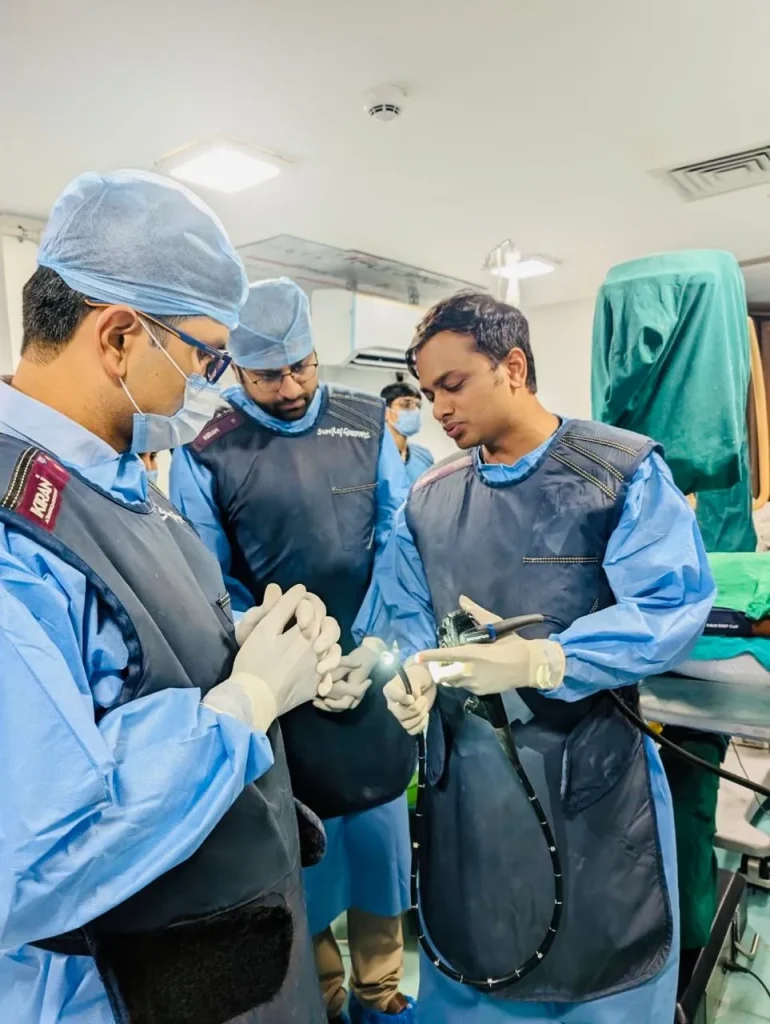
Removing a stent is quicker and simpler than the first ERCP. Under sedation, a side-viewing endoscope is passed to the duodenum, and the end of the stent is grasped with a snare or forceps and pulled out. If the problem has not fully settled, the doctor may clear the duct again or place a fresh stent in the same sitting. The procedure usually takes 15 to 30 minutes, and most people go home the same day.
Preparation is like any endoscopy: fast for six to eight hours, bring your earlier ERCP report, tell the team about blood thinners and come with an adult who can take you home.
Life with a stent
You can eat normally, work, travel and exercise with a stent in place. There is no special diet. Keep your discharge papers, which list the stent type and date, and carry them if you travel. If you need gallbladder surgery after a CBD stone, the surgeon and the endoscopist will agree on timing; often the stent is removed after the surgery.

Questions to ask before you leave hospital
- Is my stent plastic or metal, and is it in the bile duct or the pancreatic duct?
- On which date should it be removed or changed?
- Was the bile duct fully cleared, or is a second ERCP planned?
- Do I need gallbladder surgery, and should it happen before or after the stent comes out?
- Whom should I call if I get fever or yellow eyes at night?
Ask the team to write the answers on your discharge summary. In a stressful week, it is easy to forget what was said at the bedside.
Cost and insurance
Stent removal costs less than the original ERCP, because it is shorter and simpler. A stent change, where a new one is placed, costs more than a plain removal. Both are hospital procedures and are usually covered by health insurance. The clinic gives you an estimate once your earlier report has been reviewed.
ERCP stent care in Delhi
Dr. Shrihari Anikhindi performs ERCP, stent change and stent removal at Apollo Hospitals. Follow-up and planning happen at Medigest in West Punjabi Bagh, Delhi, so if you live in Punjabi Bagh, Paschim Vihar, Rajouri Garden or anywhere in West Delhi, the clinic is close by. If your stent was placed at another hospital and you are not sure when it is due, bring the discharge summary to a consultation, or send it for an online consultation, and we will help you plan the next step.
A stent is a simple, effective fix, as long as it comes out on time. Put the date in your phone today.
Medically reviewed by Dr. Shrihari Anikhindi, MBBS, MD, DNB (Gastroenterology), MRCP (SCE), gastroenterologist and advanced endoscopist at Medigest Gastro, Liver & Endoscopy Clinic, West Punjabi Bagh, Delhi. This article is general information. Please talk to your own doctor about your health.