
"Will it hurt?" is the question we hear more than any other before a colonoscopy. It is also, quite often, the reason people put the test off for months, sometimes years. So it deserves a straight answer.
For most people, a colonoscopy is not painful. With sedation, many sleep through it and remember very little. Without sedation, there is some cramping, a bit like wind pain, that comes and goes. And if you ask patients afterwards, a surprising number say the worst part was drinking the bowel preparation the day before, not the test itself.
Here is what actually happens, what you are likely to feel at each stage, and how to make it as comfortable as possible.
What you feel during the test
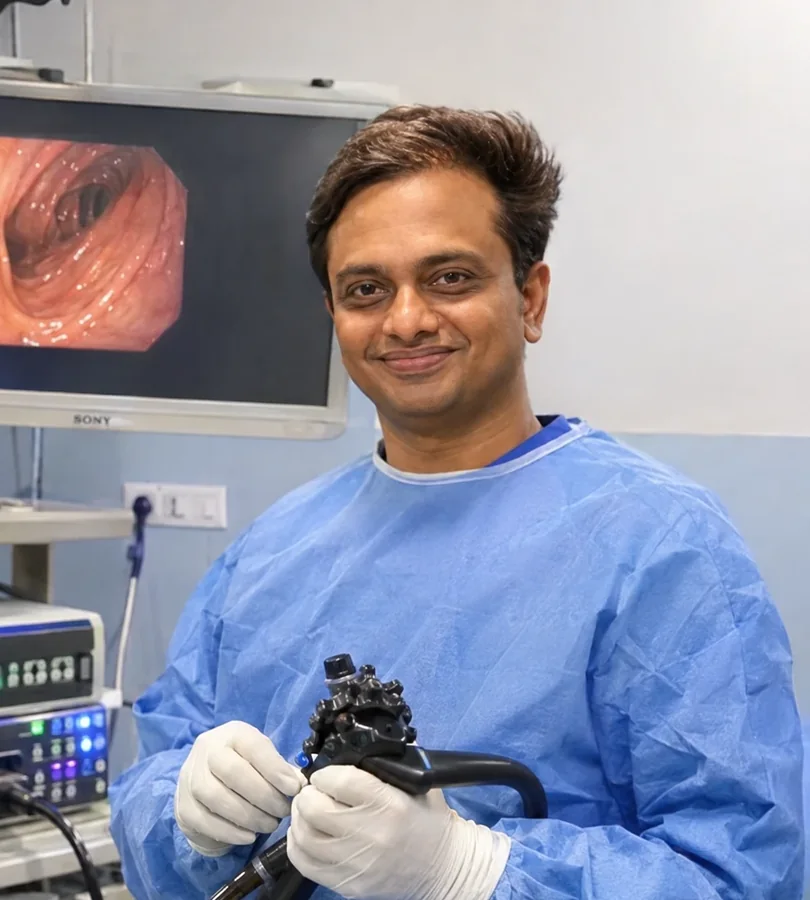
The colonoscope is a long, thin, flexible tube with a camera and a light at its tip. It goes in through the back passage and is guided gently around the large intestine. The colon is not a straight pipe; it has several bends, and two of them are fairly sharp. When the scope goes round these bends, or when air or carbon dioxide is used to open the bowel so the doctor can see, you may feel pressure, cramping or a strong urge to pass gas.
This feeling usually lasts a few seconds at a time. The team can ease it by changing your position, pressing lightly on your tummy, or letting some of the air out. Telling the doctor how you feel genuinely helps; it is not a test of endurance.
Colonoscopy with sedation
Most people choose sedation, and we think that is a sensible choice for a first colonoscopy. A small dose of medicine is given through a drip in your arm. Within a minute or two you feel drowsy and relaxed. Many people drift off and wake up when it is already over.
Sedation is given and watched by a trained team. Your oxygen level, pulse and blood pressure are monitored the whole time, and you are given oxygen through a small tube under the nose. Because the medicine slows your reactions for several hours, you need an adult to take you home, and you should not drive or go back to work that day.
Colonoscopy without sedation
Some people prefer to stay awake. Maybe they need to drive home, or go back to work, or they have a medical reason to avoid sedation. That is possible, and plenty of people manage well, especially if the bowel is clean and they have had no abdominal surgery. Expect more cramping at the bends. If you are unsure, talk it through with the doctor beforehand; there is no wrong choice.
How long does it take?
The examination itself usually takes 20 to 45 minutes. If polyps are found and removed, add a few more minutes. From the time you arrive to the time you leave, including the check-in, the test and resting while the sedation wears off, plan for two to three hours.
Does removing a polyp hurt?
No. The lining of the colon does not feel cutting or heat the way skin does. Small polyps are lifted off with a wire loop or tiny forceps, and you won't feel it. This is one of the big advantages of colonoscopy: it can find and remove a polyp in the same sitting, which can prevent bowel cancer from developing in the first place.
After the colonoscopy
It is normal to feel bloated and to pass quite a lot of gas for a few hours. Walking around helps. If a biopsy was taken or a polyp removed, you may see a small streak of blood in the stool once or twice. You can usually eat a light meal once you are fully awake.
Please call the clinic or go to the nearest hospital if you have:
- severe or worsening tummy pain, or a hard, swollen abdomen
- fever or chills
- more than a small amount of bleeding, or bleeding that keeps coming
- dizziness or fainting
These are uncommon, but it is important to act quickly if they happen.
A note for women having a colonoscopy
Many women tell us they feel shy or anxious about the test, and that is completely understandable. You change into a gown with an opening at the back, you lie on your side, and you stay covered throughout; only a small area is exposed while the scope is in place. If you would feel more comfortable with a female staff member in the room, please mention it when you book so it can be arranged where possible.
Women who have had a hysterectomy, a caesarean section or other pelvic surgery sometimes have a more angled colon, which can mean more cramping without sedation. This is one more reason to tell the doctor about past operations. If you are pregnant or might be, say so beforehand; a colonoscopy is usually postponed unless it is urgent. Periods are not a reason to cancel the test.
Ways to make it more comfortable
Do the preparation well. A clean colon means a shorter, smoother test with less air needed. Our colonoscopy preparation guide walks you through it day by day.
Mention past surgery. Hysterectomy, caesarean section or other abdominal operations can leave the colon more twisted. Knowing this in advance helps the doctor plan.
Breathe slowly and speak up. Slow breathing relaxes the tummy muscles. If something hurts, say so; there is nearly always something the team can do.
Ask about sedation early. If you are anxious, choosing sedation from the start is better than trying without it and stopping midway.
Is it worth it?
When a colonoscopy is advised, yes. It is the most reliable way to find the cause of bleeding from the back passage, unexplained anaemia, or a change in bowel habit that has lasted for weeks. And because polyps can be removed during the same test, it is one of the few tests that can actually prevent a cancer rather than just find one.
If the fear of pain has been holding you back, it is worth simply having a conversation first. You can learn more about the colonoscopy test at Medigest, see how it compares with an upper GI endoscopy, or book a consultation with Dr. Shrihari Anikhindi to talk it through before deciding.
Medically reviewed by Dr. Shrihari Anikhindi, MBBS, MD, DNB (Gastroenterology), MRCP (SCE), gastroenterologist and advanced endoscopist at Medigest Gastro, Liver & Endoscopy Clinic, Delhi. This article is general information. Please talk to your own doctor about your health.