
"Cyst in the pancreas" is a phrase that frightens almost everyone who reads it on a CT or MRI report. The word pancreas makes people think of cancer straight away. The truth is calmer: most pancreatic cysts are not cancer, and many never need any treatment. But some do, and telling them apart is exactly where endoscopic ultrasound helps. Here is how we think about them.
Two very different kinds of cyst
Broadly, a fluid-filled lump in or near the pancreas is one of two things:
- A pseudocyst or fluid collection, which forms after an attack of pancreatitis. It is not a true cyst and is not cancerous.
- A true cystic lesion of the pancreas, such as a serous cystadenoma, an IPMN or a mucinous cystic neoplasm. These usually turn up by chance on a scan. Some are harmless; a few can turn into cancer over time.
The story behind the cyst matters as much as the scan. A cyst that appeared weeks after a bad attack of pancreatitis is almost always a pseudocyst. A cyst found in someone who has never had pancreatitis is more likely to be a true cystic lesion.
What is a pseudocyst of the pancreas?
During acute pancreatitis, fluid leaks out of the inflamed pancreas. In most people this fluid is reabsorbed. In some, the body walls it off, and after about four weeks it becomes a pseudocyst, a pocket of pancreatic fluid with a wall of scar tissue. Pseudocysts are also seen in chronic pancreatitis, often in people who drink alcohol regularly. When the collection also contains dead pancreatic tissue, it is called walled-off necrosis, which behaves differently and is managed more carefully.
Does a pseudocyst need treatment?
Many pseudocysts shrink and disappear on their own over weeks to months, and we simply watch them with scans. Size alone is not a reason to drain. Treatment is advised when the pseudocyst:
- Causes pain that does not settle.
- Presses on the stomach, causing early fullness, vomiting or weight loss.
- Blocks the bile duct, causing jaundice.
- Becomes infected, with fever.
- Keeps growing, or bleeds.
EUS-guided drainage: no surgery, no tube outside
Most pseudocysts sit right against the back wall of the stomach. With endoscopic ultrasound (EUS), the doctor can see the pseudocyst through the stomach wall, check that no blood vessel is in the way, and make a small opening between the two. A stent is placed through the opening so the fluid drains into the stomach, where it is harmless. Depending on the collection, this is either a pair of small plastic stents or a wider metal stent (often called a LAMS).
The whole procedure is done through the mouth under sedation or anaesthesia. There is no cut on the skin and no drainage bag hanging outside the body. Compared with surgery, recovery is faster and the hospital stay is shorter, and studies show it works just as well for suitable patients. The stents are removed with a simple endoscopy once the cavity has collapsed, usually after a few weeks. If there is a lot of dead tissue, the doctor may need to clean the cavity through the stent in one or more sessions.
True cysts of the pancreas: watch or treat?
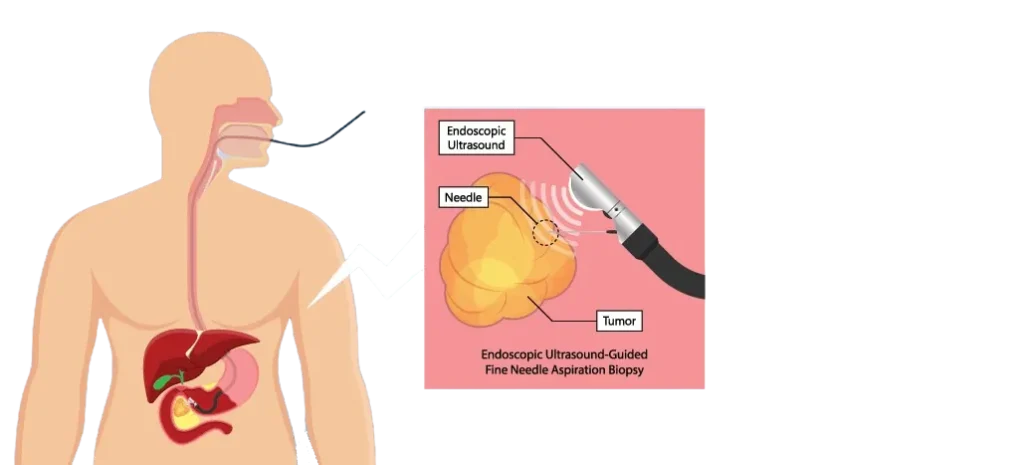
For cysts that did not follow pancreatitis, the aim is to work out the type and the risk. MRI with MRCP is the main imaging test. EUS is added when the cyst has features that need a closer look, such as a solid part inside it, a thick wall, a widened pancreatic duct, or growth over time. During EUS, a fine needle can take fluid from the cyst for tests, including cancer cells and markers such as CEA. This is called EUS-FNA.
- Serous cystadenomas are almost always benign and often just need reassurance.
- Small IPMNs without worrying features are usually watched with MRI at set intervals.
- Cysts with worrying features are discussed with a pancreatic surgeon, as removing them early can prevent cancer.
Pancreatic cyst symptoms
Most true cysts cause no symptoms and are found by chance. Pseudocysts can cause upper abdominal pain, fullness after small meals, nausea and weight loss. Warning signs that need prompt attention include jaundice, fever, new-onset diabetes in an older adult, unexplained weight loss, or bleeding.
Questions to ask your doctor
- Is this a pseudocyst after pancreatitis, or a true cyst of the pancreas?
- Does it have any worrying features, such as a solid part or a widened duct?
- Do I need an EUS, or is an MRI follow-up enough?
- If it needs draining, will plastic or metal stents be used, and when will they come out?
- How often should the cyst be checked, and with which scan?
- Which symptoms mean I should come back sooner?
Is EUS safe?
EUS is a commonly performed procedure with a low complication rate. Drainage and needle sampling add small risks of bleeding, infection or leakage, which the doctor will discuss with you. Before the procedure you will need blood tests, and blood thinners may need to be paused. You will need to fast for six to eight hours and come with someone who can take you home.

Pancreatic cyst treatment in Delhi
Dr. Shrihari Anikhindi has a special interest in endoscopic ultrasound and has published research on EUS-guided procedures. Patients from across Delhi NCR start with a consultation at Medigest Gastro, Liver & Endoscopy Clinic in West Punjabi Bagh, where CT and MRI scans are reviewed and the need for EUS is decided. EUS and drainage are performed at Apollo Hospitals, and follow-up can be at the clinic or online. If you are in West Delhi, Punjabi Bagh, Paschim Vihar or Rajouri Garden, you can book a visit. If you live further away, you can send your scans for an online consultation first.
A cyst in the pancreas is a reason to get the right opinion, not a reason to panic. Most are harmless, pseudocysts usually settle or can be drained from the inside, and the few that matter can be found early.
Medically reviewed by Dr. Shrihari Anikhindi, MBBS, MD, DNB (Gastroenterology), MRCP (SCE), gastroenterologist and advanced endoscopist at Medigest Gastro, Liver & Endoscopy Clinic, West Punjabi Bagh, Delhi. This article is general information. Please talk to your own doctor about your health.