
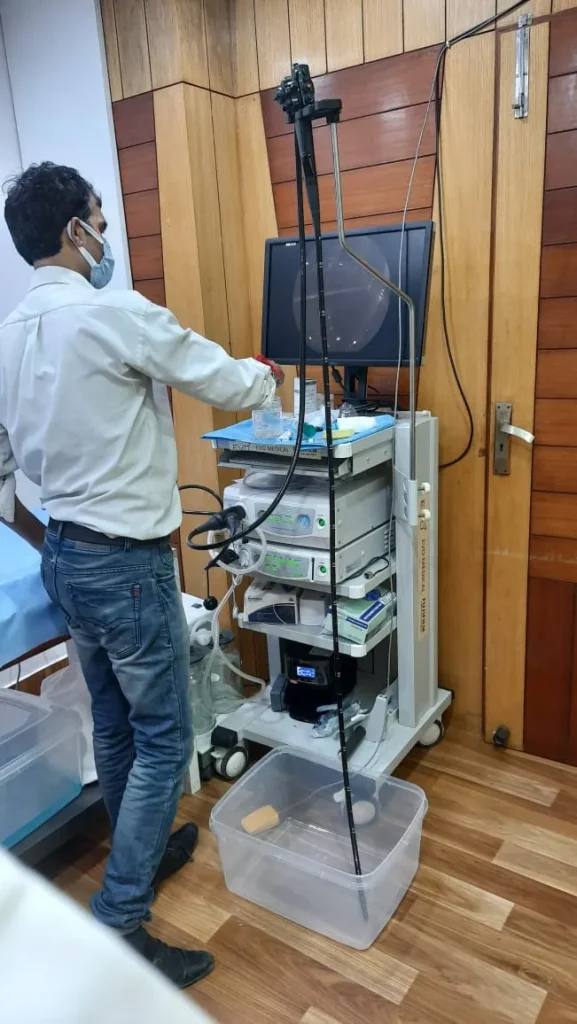
When someone is diagnosed with achalasia, the first question is usually "Is there a tablet for this?" Sadly, there isn't. The second question, once they have searched online, is "Should I have POEM or Heller myotomy?" Both are good operations for the same problem, and both work in about nine out of ten people. The right choice depends on your type of achalasia, your age, your earlier treatment and how you feel about reflux. Here is a straightforward comparison.
First, what both treatments do
In achalasia, the valve at the bottom of the food pipe (the lower oesophageal sphincter) does not relax, and the food pipe loses its ability to push food down. Food and water get stuck in the chest and come back up. You can read the warning signs of achalasia cardia for more on symptoms.
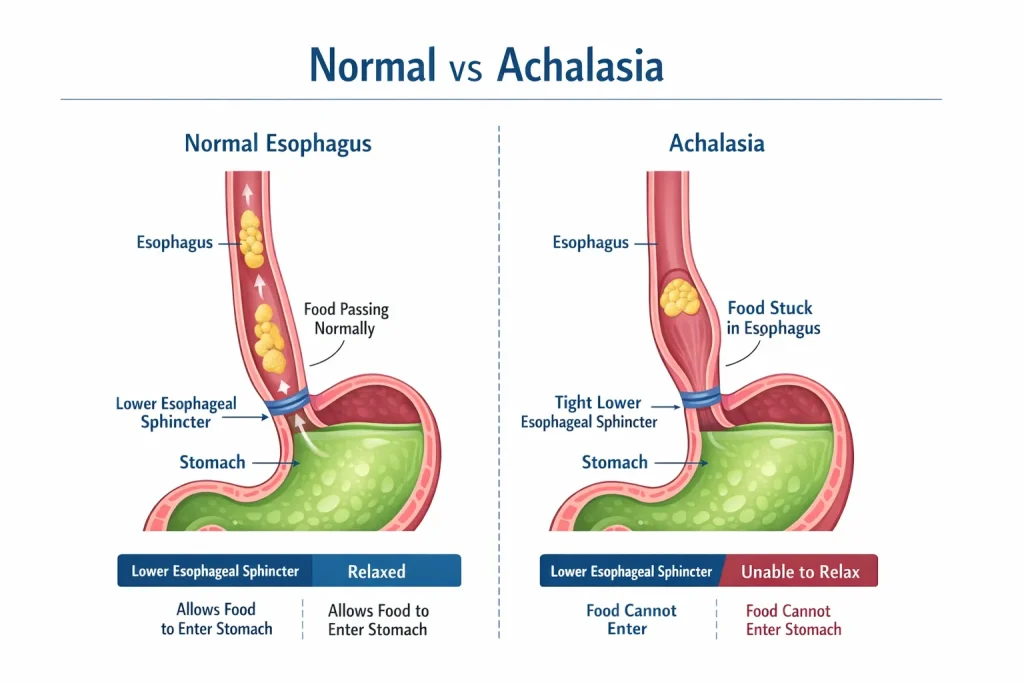
Both POEM and Heller myotomy fix this the same way: by cutting the tight muscle of the valve so that it can no longer squeeze shut. The difference is how the surgeon or endoscopist gets to that muscle.
Heller myotomy: keyhole surgery from the outside
A laparoscopic Heller myotomy is done by a surgeon under general anaesthesia, through five or so small cuts on the abdomen. The surgeon reaches the outside of the lower food pipe, cuts the muscle layer, and usually wraps part of the stomach around the area (a partial fundoplication, often a Dor or Toupet) to reduce acid reflux afterwards. The hospital stay is usually one to three days.
POEM: endoscopic treatment from the inside
POEM, or per-oral endoscopic myotomy, is done with an endoscope passed through the mouth, also under general anaesthesia. The endoscopist makes a small opening in the lining of the food pipe, creates a tunnel within its wall, cuts the muscle from inside, and closes the opening with clips. There are no cuts on the skin. Most people stay one or two nights. Our POEM procedure page explains the steps and recovery in detail.
POEM vs Heller myotomy side by side
- How well it works: very similar. Both relieve swallowing in about 85 to 95 percent of people, and large studies comparing them show equal results over several years.
- Cuts on the body: none with POEM; several small keyhole cuts with Heller.
- Length of the cut muscle: POEM can be made as long as needed, even far up the food pipe. Heller is limited to the lower part. This matters in type III achalasia.
- Acid reflux afterwards: more common after POEM, because no anti-reflux wrap is added. Many POEM patients need an acid-reducing tablet, sometimes long term. Heller with a partial wrap has less reflux.
- Pain and recovery: generally a little quicker with POEM.
- After earlier treatment: POEM works well after a failed Heller myotomy or balloon dilatation, because it reaches the muscle from a different side.
Which one is right for you?
We usually lean towards POEM for:
- Type III (spastic) achalasia, where a longer cut is needed to relieve chest pain and spasm.
- People whose symptoms have come back after Heller myotomy or dilatation.
- People who strongly prefer to avoid abdominal surgery, or who have had previous abdominal operations.
Heller myotomy may be the better choice for:
- People who already have significant acid reflux or a hiatus hernia.
- People who very much want to avoid long-term acid-reducing tablets.
- Situations where an experienced POEM team is not available.
For type I and type II achalasia, both are good options, and the decision comes down to the points above and a frank talk about reflux. Balloon dilatation is a third option for some people with type II achalasia. It is done during an endoscopy, though it may need repeating over the years.
The test that decides: esophageal manometry
Before any treatment, achalasia should be confirmed and typed with esophageal manometry. An upper GI endoscopy is done first to rule out a narrowing or growth that can look like achalasia. A barium swallow shows how wide the food pipe is and how slowly it empties. These tests also help after treatment, to check how well the food pipe is emptying.
Questions to ask before you choose
- Which type of achalasia do I have on manometry, and does it favour one treatment?
- Do I already have reflux or a hiatus hernia?
- How many of these procedures does the team do each year?
- How long will I stay in hospital, and when can I go back to work?
- What happens if my symptoms come back after a few years?
- Will I need acid-reducing tablets afterwards, and for how long?
Write your answers down and take your time. Achalasia is rarely an emergency, and a week spent deciding is never wasted.
Life after either procedure
After both procedures, people start with liquids, move to soft food over one to two weeks, and are then back to a normal diet. Eat slowly, chew well and sit upright for a while after meals. A check endoscopy after POEM looks for reflux damage, and the dose of acid-reducing medicine is adjusted. Achalasia is a long-term condition, so keep your follow-up visits even when you feel well. If symptoms come back years later, they can usually be treated again.
Achalasia treatment in Delhi
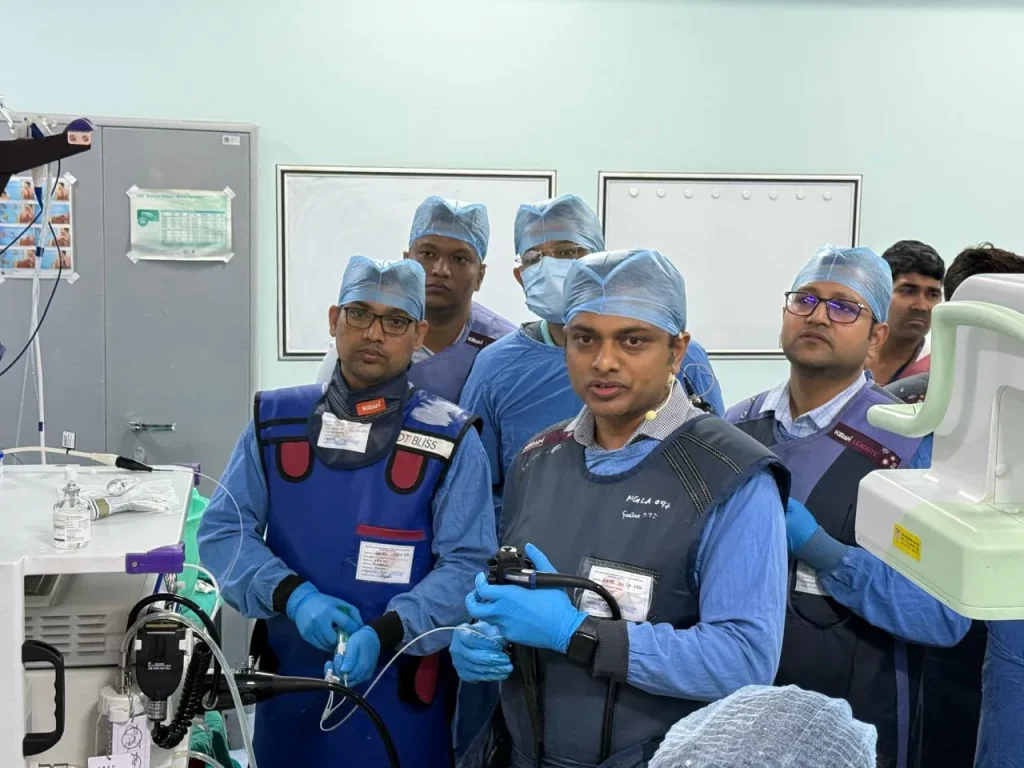
Dr. Shrihari Anikhindi trained in advanced endoscopy in Japan and in gut motility in South Korea, and performs POEM at Apollo Hospitals. Patients from all over Delhi come first to Medigest in West Punjabi Bagh, where the diagnosis is confirmed, manometry is planned, and the options, including surgery where that suits better, are discussed honestly. If you live in Punjabi Bagh, Paschim Vihar, Rajouri Garden or anywhere in West Delhi, the clinic is easy to reach for follow-up. You can book a consultation, or start with an online consultation and send your reports.
The good news about achalasia is that both treatments work well. The best choice is the one that fits your type of achalasia and your life, and that is a decision worth taking slowly, with all your tests in hand.
Medically reviewed by Dr. Shrihari Anikhindi, MBBS, MD, DNB (Gastroenterology), MRCP (SCE), gastroenterologist and advanced endoscopist at Medigest Gastro, Liver & Endoscopy Clinic, West Punjabi Bagh, Delhi. This article is general information. Please talk to your own doctor about your health.