
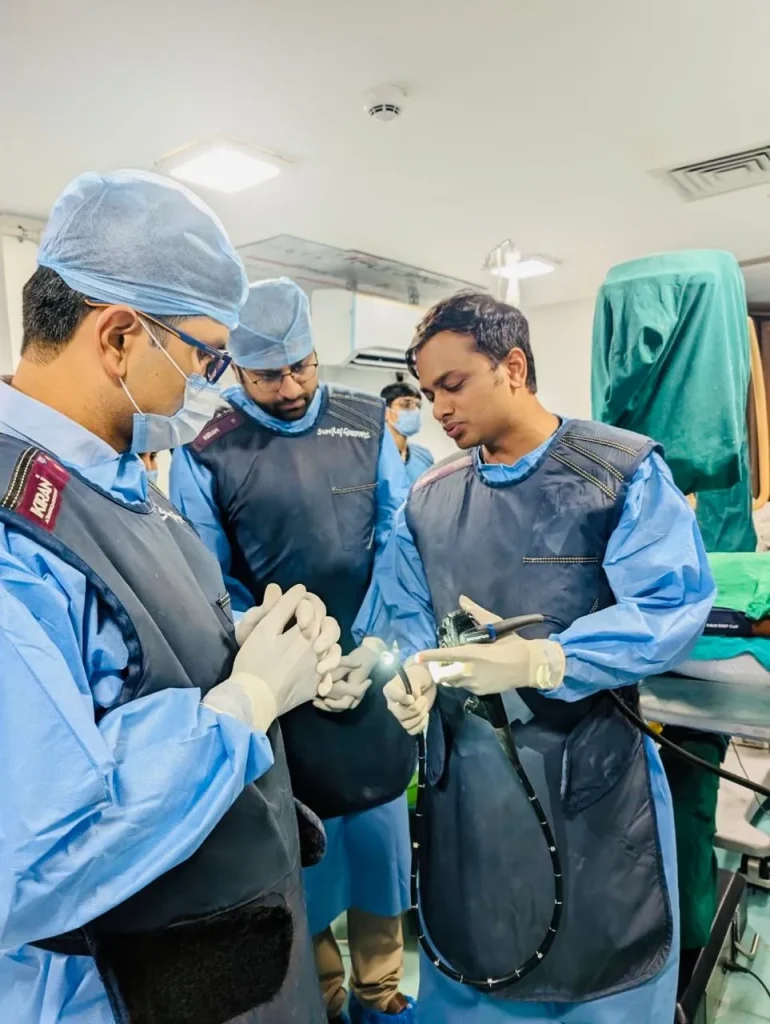
An upper GI endoscopy is one of the most useful tests in gastroenterology, because it lets the doctor look directly at the lining of your food pipe, stomach and duodenum rather than guess from symptoms. If something looks abnormal, a tiny piece of tissue can be taken there and then. Patients often ask us what exactly it can pick up, and just as often, what it can't. Here is a practical list.
If you have not had the test yet, you can read about the endoscopy test at Medigest first.
13 things an endoscopy can find
1. Reflux oesophagitis (GERD)
Long-standing acid reflux can inflame the lower food pipe. Endoscopy shows how much damage there is, and doctors grade it from mild to severe. This helps decide how long treatment should continue. More on GERD.
2. Barrett's oesophagus
In some people with years of reflux, the lining of the lower food pipe changes its type. This is called Barrett's oesophagus. It is not cancer, but it needs regular check-ups because of a small long-term risk. It can only be confirmed with endoscopy and biopsy. Read more about Barrett's oesophagus.
3. Gastritis
Inflammation of the stomach lining is very common. Endoscopy shows where it is and how severe, and biopsies help find the cause: H. pylori infection, painkillers, alcohol, or less often, autoimmune problems.
4. Stomach and duodenal ulcers
Ulcers cause burning pain, vomiting, bleeding or black stools. Endoscopy confirms them, checks whether they are bleeding, and allows a biopsy from stomach ulcers to make sure they are harmless. A repeat test is sometimes needed to confirm healing.
5. H. pylori infection
This bacterium lives in the stomach and is a major cause of ulcers. During endoscopy, a rapid urease test (RUT) on a small biopsy gives an answer within hours. Without endoscopy, a urea breath test can be used. See H. pylori symptoms and treatment.
6. Coeliac disease
A blood test may suggest coeliac disease, but small biopsies from the duodenum confirm it by showing the typical damage caused by gluten.
7. Hiatus hernia
When part of the stomach slides up through the diaphragm into the chest, reflux becomes more likely. Endoscopy shows its size.
8. Varices
People with cirrhosis can develop swollen veins in the food pipe or stomach. These can bleed heavily. Endoscopy finds them early, and they can be treated with small rubber bands during the same test to reduce the risk of bleeding. Read about liver care.
9. The source of bleeding
Vomiting blood or passing black stools is an emergency. Endoscopy finds where the bleeding is coming from, and in many cases the doctor can stop it during the same procedure with injections, clips or heat.
10. Narrowing of the food pipe
If food sticks on the way down, endoscopy can show a stricture (narrowing) and stretch it with a balloon or dilator. Biopsies make sure the narrowing is not caused by something more serious.
11. Polyps
Small growths in the stomach or duodenum are usually harmless, but they are sampled or removed so the laboratory can check them.
12. Early cancer
Cancers of the food pipe and stomach are much easier to treat when found early. Modern high-definition scopes and narrow band imaging help the doctor spot subtle changes in the lining, and some early cancers can even be removed through the scope with advanced endoscopy.
13. Swallowed objects
Coins, bones, dentures and other objects that get stuck can often be removed with endoscopy, avoiding surgery.
What an endoscopy cannot see
An endoscopy only shows the inner lining of the upper gut. It won't show:
- The liver, gallbladder and pancreas. These need ultrasound, CT, MRI or endoscopic ultrasound.
- Most of the small intestine. It is several metres long; capsule endoscopy is used to see it.
- The large intestine. That needs a colonoscopy.
- Functional problems. In irritable bowel syndrome or functional dyspepsia the lining looks normal, even though the symptoms are real.
A normal endoscopy is still useful. It rules out ulcers, inflammation and serious disease, which often reassures people and lets the doctor focus on other causes.
Is an endoscopy safe?
Diagnostic endoscopy is one of the safest procedures in medicine. Serious problems such as bleeding or a tear in the gut wall are rare, and the risk is lower still for a simple look with or without biopsies. Most side effects are minor: a sore throat for a day, some bloating, or drowsiness after sedation. The risk is slightly higher when treatment is done during the test, for example stopping bleeding or stretching a narrowing, and the doctor will explain this beforehand. Before any test, tell the team about heart or lung problems, allergies and blood thinners, so they can plan safely.
How to prepare for an endoscopy
Preparation is much simpler than for a colonoscopy. You need an empty stomach, so don't eat for six to eight hours before the test; small sips of water are usually allowed until two hours before. Take your blood pressure tablets with a sip of water unless told otherwise. Tell the clinic in advance if you take blood thinners or diabetes medicines, because the doses may need changing.
Bring earlier reports and a list of medicines. If you choose sedation, come with an adult and plan not to drive for the rest of the day. After the test, you can usually eat once the throat spray wears off, in about an hour.
Getting your results
The doctor tells you what was seen as soon as you are awake, and you usually get the printed report with pictures the same day. Biopsy results take a few more days. If the report has words you don't recognise, our guide to reading an endoscopy report explains the common ones, and why biopsies are taken covers the rest.
When to ask about an endoscopy
Talk to a gastroenterologist if acidity or upper tummy pain keeps coming back, if swallowing is difficult, or if you are over 50 and have new symptoms. Go to a hospital straight away if you vomit blood or pass black stools. Book an appointment with Dr. Shrihari Anikhindi if you would like your symptoms checked.
Medically reviewed by Dr. Shrihari Anikhindi, MBBS, MD, DNB (Gastroenterology), MRCP (SCE), gastroenterologist and advanced endoscopist at Medigest Gastro, Liver & Endoscopy Clinic, Delhi. This article is general information. Please talk to your own doctor about your health.