
A FibroScan report is a small sheet of paper with a lot of numbers on it, and most people we meet have already searched every one of them before they reach the clinic. Some come in worried about a "bad" score that turns out to be fine. Others are relaxed about a number that actually needs attention. So let's go through the report the way we explain it to patients at our clinic in West Punjabi Bagh, one line at a time.
If you have not had the test yet, the FibroScan test page explains how it is done and how to prepare. This article is about reading the result.
The two numbers that matter
Your report has many boxes, but only two results really matter:
- Liver stiffness, in kPa (kilopascals). This tells us how much scarring, or fibrosis, there is. A healthy liver is soft. Scarring makes it stiffer.
- CAP score, in dB/m. CAP stands for controlled attenuation parameter. It tells us how much fat there is in the liver.
These two measure different things. A person can have a lot of fat and almost no scarring, or the other way round. Scarring is what decides the long-term risk, so when we look at a report, the kPa number gets our attention first.
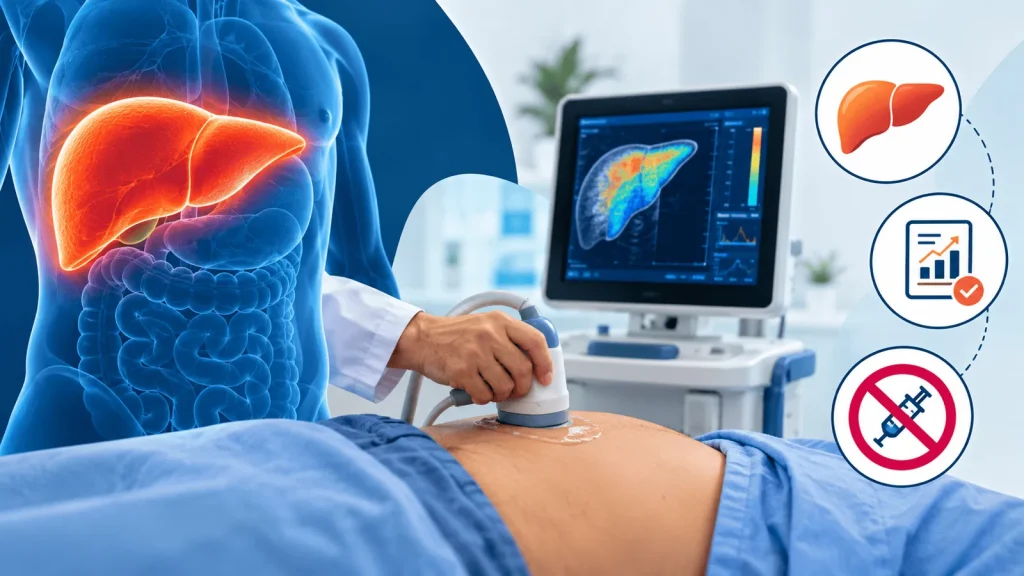
FibroScan normal range for liver stiffness (kPa)
As a rough guide for fatty liver disease, which is what most of our patients have:
- Below 7 kPa: usually normal, or very little scarring (F0 to F1).
- 7 to about 9.5 kPa: mild to moderate scarring is possible (around F2).
- About 9.5 to 12.5 kPa: significant scarring is likely (around F3).
- Above 12.5 to 15 kPa: cirrhosis is possible and needs a proper assessment (F4).
Please treat these as a guide, not a verdict. The cut-offs are a little different for hepatitis B, hepatitis C and alcohol-related liver disease, and a single reading on the border between two stages can go either way. That is why the same number can mean "come back in a year" for one person and "let's do a few more tests" for another.
CAP score: how much fat is in the liver
CAP readings run from about 100 to 400 dB/m. Different machines and labs use slightly different cut-offs, but a common way of grading is:
- Below about 248 dB/m: no significant fat (S0).
- About 248 to 268: mild fatty liver (S1).
- About 268 to 280: moderate fatty liver (S2).
- Above about 280: severe fatty liver (S3).
We get asked about a "CAP score of 300" almost every week. It means there is a lot of fat in the liver, and it deserves action. On its own, though, it does not mean the liver is damaged. A CAP of 300 with a stiffness of 5 kPa is a warning sign you can still reverse fully. A CAP of 300 with a stiffness of 13 kPa is a different conversation.
IQR, median and "valid measurements"
Lower down, the report shows how reliable the test was. The machine takes at least ten readings, and the kPa result is the median of those readings. The IQR/median ratio shows how much the readings varied. If it is 30 percent or less, the result is reliable. If it is much higher, the result may be off, often because of a recent meal, a lot of belly fat or a hard-to-find spot between the ribs. In that case, we repeat the scan rather than guess.
What makes a FibroScan result look worse than it is
A high stiffness reading is not always scarring. These things can push the number up:
- Eating within about three hours before the test. This is why we ask you to fast.
- Recent heavy drinking.
- Active inflammation, for example a flare of hepatitis, when SGOT and SGPT are very high.
- A blocked bile duct or heart failure, which make the liver swollen and tense.
So if your report shows a high number, look at the blood tests from the same week before you panic. Quite often the stiffness drops once the inflammation settles.
What counts as a bad FibroScan result?
The results we take most seriously are a stiffness above about 12 kPa, a stiffness that keeps rising from one scan to the next, or a raised stiffness together with low platelets. These suggest advanced scarring. The next steps usually include blood tests, an ultrasound and sometimes an upper GI endoscopy to check for swollen veins (varices) in the food pipe, which can bleed if they are missed.
A few people need a liver biopsy when the numbers do not fit the rest of the picture, but most do not. You can read about the early signs and stages of cirrhosis if your report has raised that question.
A good result does not mean you can ignore the fat
The opposite mistake is common too. Someone sees "F0 to F1" and decides the CAP score does not matter. But fat is how scarring starts. Losing about 7 to 10 percent of body weight over six months to a year, walking or exercising most days, cutting sugar, sweet drinks and fried snacks, and controlling diabetes can bring the CAP score down a long way. We have seen patients drop from the S3 range to normal. A repeat FibroScan after 6 to 12 months shows you the change, which is great motivation. If your ultrasound mentioned a grade, read our guide on fatty liver grade 2.

Questions to ask about your report
- Is my stiffness result reliable (IQR/median below 30 percent)?
- Which fibrosis stage does my kPa reading match, for my type of liver disease?
- Do my blood tests and platelet count fit this result?
- Do I need an endoscopy or any other test?
- When should I repeat the FibroScan?
Getting a FibroScan in Delhi
At Medigest, the FibroScan is done at our clinic in West Punjabi Bagh, Delhi, and Dr. Shrihari Anikhindi goes through the result with you in the same visit, together with your blood tests and ultrasound. Patients come to us from Punjabi Bagh, Paschim Vihar, Rajouri Garden, Janakpuri and across West Delhi. The test takes about 15 minutes and needs a three-hour fast. If you already have a report from another centre, you can also consult online and we will go through it with you. For a full plan, see our liver specialist care in Delhi.
The numbers on a FibroScan report are useful, but they are only half the story. The other half is you: your weight, your sugar, your drinking, your family history. Put the two together with a doctor, and the report stops being scary and starts being a plan. Book a FibroScan or consultation.
Medically reviewed by Dr. Shrihari Anikhindi, MBBS, MD, DNB (Gastroenterology), MRCP (SCE), gastroenterologist and advanced endoscopist at Medigest Gastro, Liver & Endoscopy Clinic, West Punjabi Bagh, Delhi. This article is general information. Please talk to your own doctor about your health.